
About
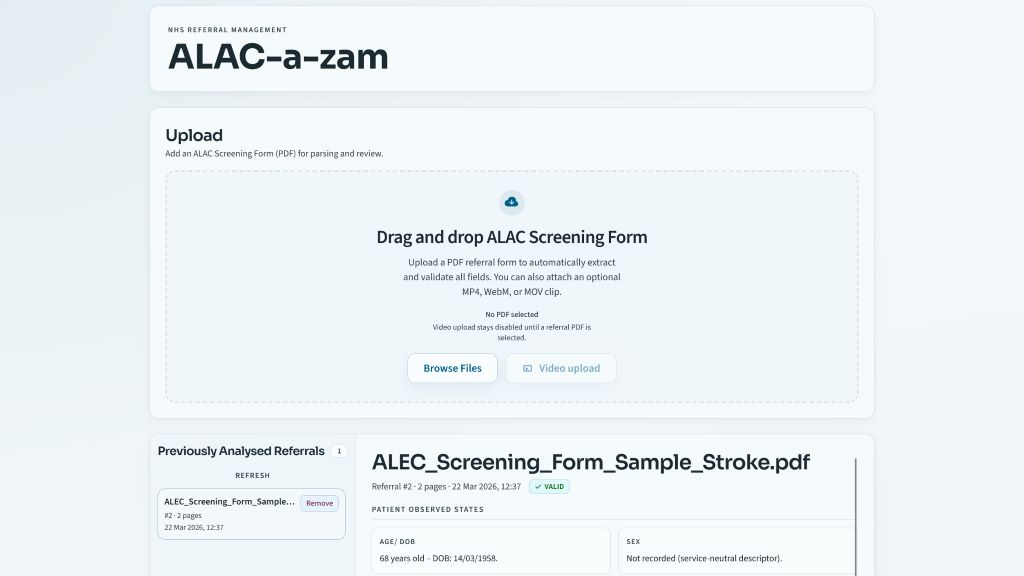 Wheelchair referrals are slow and inconsistent. ALAC-a-zam parses NHS PDF forms, applies expert clinical rules via Bayesian inference, and recommends chair specification and urgency summarised by LLM with full transparency in an accessible web app.
We selected a problem proposed by an Occupational Therapist (OT) in the Artificial Limb and Appliances Centre (ALAC), who suggested that wheelchair referrals are unnecessarily long and onerous to review. Their team spends half a day each working week reviewing them, often finding errors. This introduces costs and time wastage for a low-complexity decision on referrals. We chose to develop a decision-support tool using artificial intelligence (AI) to automate this, while ensuring that the final referral is accurately completed by a trained OT.
We built a web application that accepts the existing NHS ALAC screening form as a PDF, automatically extracts and validates clinical fields — from patient measurements and diagnoses to home-environment factors like door widths and turning circles. These fields feed into a Bayesian network developed with clinical input, encoding hard rules (such as seizure history prohibiting powered equipment, or bariatric thresholds) alongside probabilistic inference to recommend wheelchair type, size, modifications, and urgency. This ensures the recommendation is interpretable and deterministic. A Large Language Model (LLM) layer then generates transparent clinical reasoning, explaining exactly which rules and evidence led to each recommendation. The entire interface was built to WCAG AA accessibility standards, including screen reader support and keyboard navigation.
Instead of half a day spent manually reviewing referral forms, an OT can upload a PDF and receive a structured, evidence-based recommendation in seconds — one they can review, challenge, and sign off on with confidence, because every step of the reasoning is visible. Scale that across wheelchair services nationally, and you’re returning thousands of clinical hours per year to direct patient care, reducing errors in a process where mistakes mean patients get the wrong chair or wait longer than they should. The tool won’t replace the clinician but will give them a head start, so their expertise is spent on judgment, not paperwork.
Presentation Video
Website
https://referral-nhs-management.netlify.app/
Presentation
Code and Licence
Source code: https://github.com/HALP-Cardiff/NHS_Referral_Management